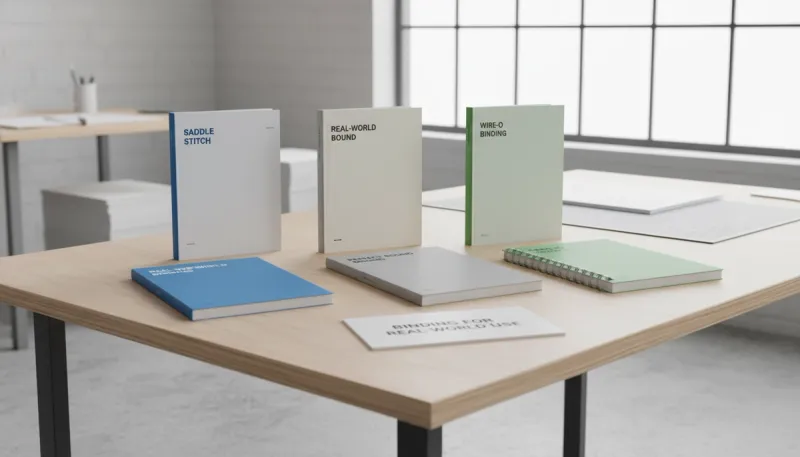
Binding isn’t a style choice—it’s a functional decision. We select saddle stitch, perfect bind or Wire‑O based on page count, handling, storage and reading ergonomics. The right spine preserves durability, keeps pages flat and makes the piece usable.
| Binding Style | Ideal Page Count | Key Benefit |
|---|---|---|
| Saddle Stitch | 8 - 64 pages | Cost-effective, lays relatively flat. |
| Perfect Bound | 40 - 200+ pages | Professional square spine, printable spine. |
| Wire-O | Manuals / Reports | Opens 360°, lies completely flat. |
Saddle Stitch (Stapled)
Best for lower page counts and economical runs. Pagination must consider creep (inner pages push outward). We compensate by adjusting margins so content doesn’t drift toward the trim. Fold integrity depends on grain direction; wrong grain causes cracking. Typical page counts: up to ~72 pages depending on stock thickness.
Perfect Binding (Glued Spine)
Ideal for higher page counts with a professional spine. We specify EVA vs PUR adhesives by use case—PUR resists heat and flex better for long life. Spine width is calculated precisely from paper caliper and page count; cover scores are set for clean wraps without cracking. For lay‑flat expectations, we adjust glue formulation and notch patterns—but perfect bind is not truly lay‑flat like Wire‑O.
Wire‑O (Double Loop)
Designed for usability in manuals and presentations. Pages turn freely and lie flat, even with heavy stocks. Punch patterns must match the coil spec; we avoid punching through critical content by designing inner margins appropriately. Covers can be soft or hard; tabs and dividers integrate well.
Choosing by Use Case
Brochures with modest pagination? Saddle stitch. Catalogues or reports with substantial content? Perfect bind. Reference manuals requiring flat pages and frequent handling? Wire‑O. We balance cost, durability, spine aesthetics and user interaction.
Production Realities
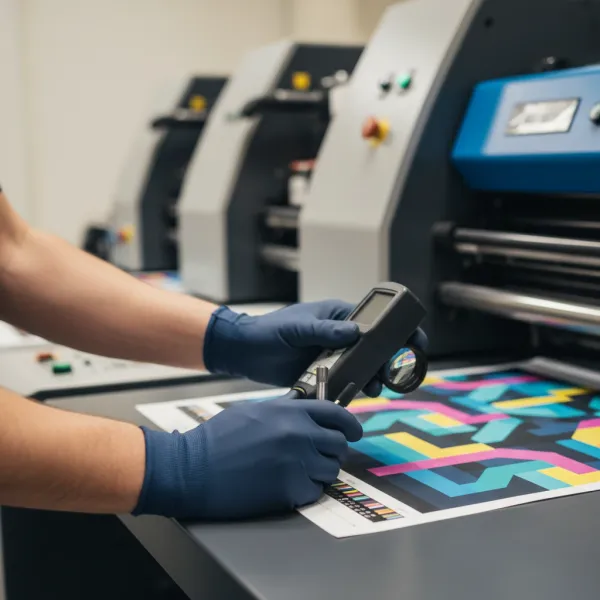
We stage binding after inks fully cure to avoid offsetting. Trim is verified at multiple points; stacks are rotated to minimise variance. For perfect bind, moisture and temperature are controlled around the binder; for Wire‑O, punch quality and alignment are inspected on a per‑batch basis.
Failures We Prevent
- Cracking at folds from wrong grain or coating on heavy stocks.
- Content drift at trim due to uncorrected creep in saddle stitch.
- Spine failures from incorrect adhesive choice or cure.
- Poor page turning from tight margins in Wire‑O designs.
Authority Standard
We treat binding as a mechanical system with constraints and tolerances. Specs, samples and QC records ensure the chosen method aligns with your usage and longevity expectations. The result: documents that look premium and behave correctly every day.