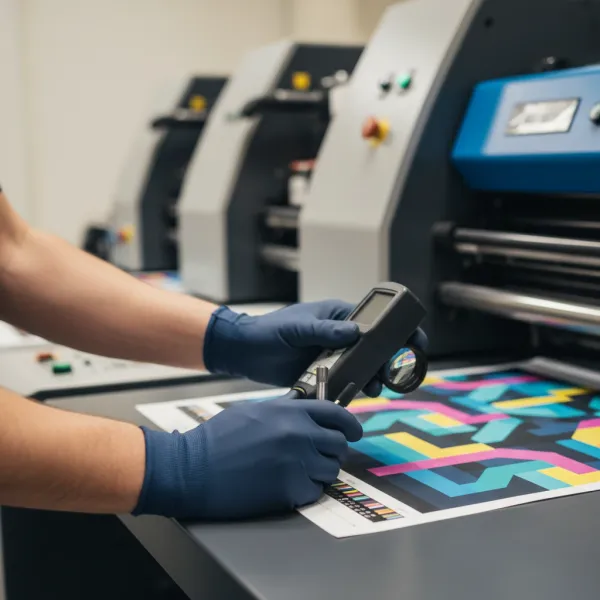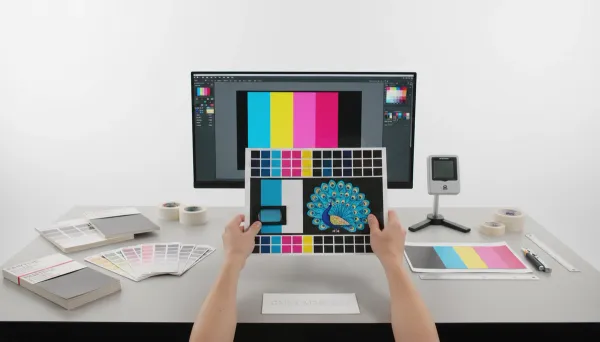
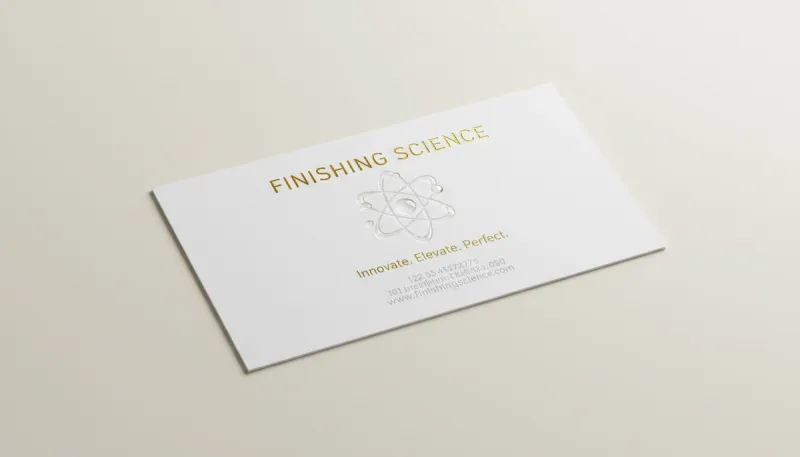
Finishing is engineering, not decoration. Lamination, Spot UV and Foil must survive the real world: handling, stacking, mailing and weather. We design finishing to perform, then prove it with controlled process and inspection.
Lamination: Film Types & Performance
Gloss amplifies colour and contrast; matt reduces glare and adds sophistication; velvet (soft‑touch) adds tactile luxury. We match film thickness and adhesive system to stock. Heavier cover stocks tolerate thicker films; lightweight stocks need thinner films to avoid curl. Adhesives are chosen for coating compatibility—poor pairing causes silvering or delamination.
Silvering & Curl Control
Silvering (micro‑air trapped) is mitigated by correct roller pressure, temperature and adhesive flow. Curl arises when film tension or moisture balance is wrong; we counter with proper grain direction, two‑sided lamination when needed, and post‑lam conditioning.
Spot UV: Registration & Laydown
Spot UV creates contrast against matt areas. Success depends on register, trap and film laydown. We design UV areas with slight trap to avoid halos, keep line weights realistic, and proof alignment on the specific stock. For raised UV, we set layer heights that remain crisp without cracking.
Foil Stamping: Dies, Heat & Pressure
Foil is a system: foil chemistry, die depth, dwell time, pressure and temperature. Coarse textures demand deeper dies; fine detail requires perfect register and clean artwork. We test on sample sheets to lock in heat/pressure curves, and we avoid placing foil across heavy folds unless reinforced.
Design for Manufacturability
We push aesthetics within physical limits: minimum type sizes for UV/foil, adequate clearances, and surfaces that actually hold a finish. Artwork layers are named clearly (e.g., Spot_UV / Foil) and set to overprint; production files include bleed and safe zones.
Field Failures We Prevent
- Soft‑touch scuffing from heavy friction without a protective plan.
- Raised UV cracking on tight folds.
- Foil drop‑outs due to insufficient heat/pressure or poor die depth.
- Delamination from incompatible coatings or low‑energy surfaces.
Quality Proof
We retain swatches with notes on film type, UV height, and foil parameters. In production, operators inspect adhesion, register and scuff resistance under bright, raking light. We ship finishes that look premium on day one—and still look premium after months of real use.