Colour is a controlled variable, not a guess. We build accuracy by standardising inputs, profiling devices and validating output under known viewing conditions. This is how we achieve repeatable colour—across different papers, coatings and presses—without excuses.
RGB (Screens)
Additive colour (Light). Gamut is huge. Neon greens and deep blues exist here but not in ink.
CMYK (Print)
Subtractive colour (Ink). Gamut is smaller. Requires precise calibration to match expectations.
Why CMYK (and not RGB)
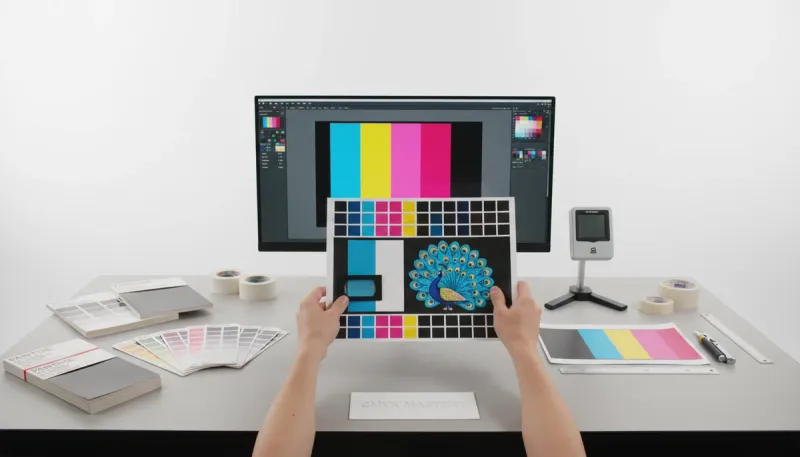
Screens emit light (RGB), presses lay down ink (CMYK). Converting late introduces unpredictable clipping and hue shifts. We keep all production assets in CMYK with FOGRA39/51 profiles so what is proofed is what is printed.
Profiles & Calibration
We maintain calibrated monitors (D65), proofers and presses. Device profiles are verified monthly and re‑made when drift appears. We use press‑condition profiles matched to typical stocks (gloss, matt, uncoated) and limit total ink coverage to avoid mottling or dry‑back issues.
Paper & Coating Influence
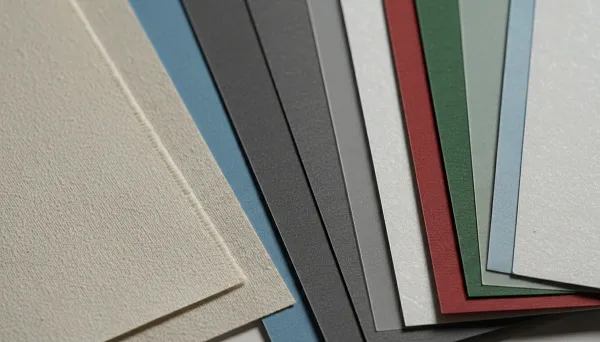
Papers absorb ink at different rates; coatings scatter light differently. Uncoated papers soften colour and increase dot gain; gloss coatings amplify saturation and specular highlights. We compensate via tone curves and ink limit adjustments so neutrals remain neutral and brand colours stay inside tolerance.
Lighting & Metamerism
Colour should be judged under controlled lighting (D50). We warn against office fluorescents or warm LEDs that skew perception. Metamerism—two patches matching under one light but diverging under another—is handled by proofing in the intended environment and choosing pigment sets that minimise the effect.
Proofing Discipline
Critical colours are proofed on representative stock whenever possible. Contract proofs carry annotations: risk on fine reversed type, metallic inks or textured substrates. Only after client sign‑off does production proceed. Internal sign‑off is separate and mandatory.
On‑Press Colour Control
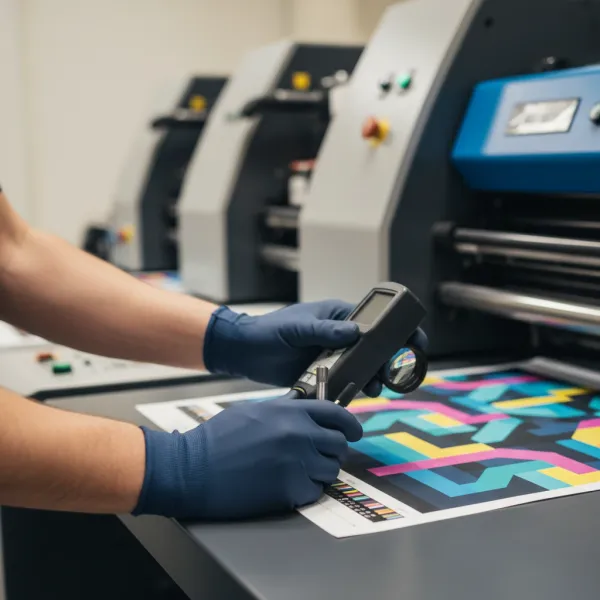
Make‑ready establishes ink densities, registration and uniformity by zone. Operators measure control bars and neutral scales; adjustments are made to stabilise densities before ramping to speed. We treat colour drift as a defect to be corrected, not tolerated.
Common Pitfalls We Prevent
- Late RGB→CMYK conversion causing hue shifts.
- Unmanaged PDFs with embedded mixed profiles.
- Total ink coverage exceeding stock capability.
- Judging colour under unsuitable lighting.
- Ignoring dot gain on uncoated papers.
Repeatability (Authority)
We record delta‑E metrics, proof references and press settings per job. Reprints use the previous records unless materials change, in which case we re‑profile. Authority isn’t claimed; it’s demonstrated by colour that matches, every time, across stocks and runs.